
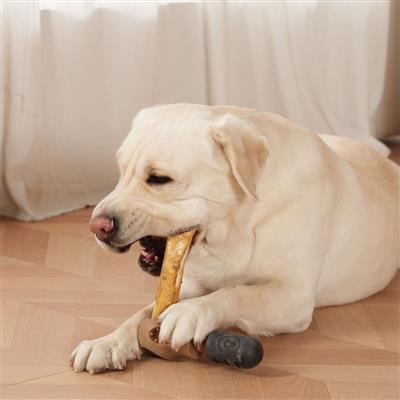
The straightforward answer: bully sticks can be an appropriate chew for many dogs when they're properly sized and supervised—but no edible chew should be treated as risk-free.
Bully sticks are digestible beef chews, but dogs don't all chew the same way. A dog that slowly gnaws at one presents a very different situation from a power chewer that tries to bite off and swallow large pieces.
Wondering what bully sticks are actually made of? Read our complete guide.
For serious chewers, the biggest things to pay attention to are size, chewing style, supervision and what happens as the bully stick gets smaller.
What Are the Risks of Bully Sticks?
The fact that a bully stick is edible doesn't mean a dog can't get into trouble with one.
The primary concern is choking or swallowing a large piece. A determined chewer may bite through a section rather than gradually work it down. A piece that's swallowed whole can also create a gastrointestinal obstruction. That's why dogs should be supervised with edible chews and why the size of the chew matters.
There is also no single chew that's appropriate for every dog. Age, dental condition, size and chewing style all matter when choosing one.
How Do You Make Bully Sticks Safer for Dogs?
You can't eliminate every risk, but you can make smarter choices.
Choose an appropriate size. A chew that's too small is easier for a dog to get entirely into its mouth and potentially swallow.
Watch how your dog actually chews. Don't assume a chew is appropriate simply because another dog of the same size does well with it.
Supervise chew sessions. This matters especially with a new chew or a dog whose chewing habits you don't know yet.
Don't let the last piece become a gulping hazard. As the bully stick gets shorter, your dog has less material to hold between its paws and may try to swallow what's left. AKC specifically recommends taking the nub away before the dog can swallow it.
When Should You Take a Bully Stick Away?
Don't wait until the bully stick disappears.
Once the remaining piece becomes small enough that your dog could potentially swallow it whole, take it away.
There isn't one universal number of inches that works for every dog. A safe remaining size for a small dog isn't necessarily appropriate for a large dog, and chewing behavior matters just as much as body weight.
The practical rule is simple:
If your dog can get the remaining piece far enough into its mouth that swallowing it whole becomes realistic, the chew session is over.
Can a Bully Stick Holder Help?
For dogs that want to swallow the last portion of a chew, a properly used bully-stick holder can provide another layer of management.
The idea is straightforward: secure the end of the bully stick so the dog can't easily gulp the final piece.
A holder does not make a chew risk-free or replace supervision. It is another tool for managing the part of the chew session where swallowing the remaining piece becomes a concern.
For dogs that tend to gulp the last piece, the Territory Treat Lock is designed to securely hold compatible chews and help keep the remaining end from being swallowed whole.
What Size Bully Stick Should You Give Your Dog?
There isn't a perfect dog-weight-to-bully-stick formula.
Instead, think about:
Dog size — the chew should be large enough that your dog can't simply swallow it.
Chewing intensity — serious power chewers may work through thin bully sticks very differently from casual chewers.
Thickness — thicker sticks give a determined chewer more material to work through.
Length — longer chews can give larger dogs more to hold while chewing.
That's one reason Rugged Dog uses defined thickness standards rather than simply calling every bully stick “thick.”

For dogs that make ordinary bully sticks disappear quickly, you can see our extra-thick bully sticks for power chewers.
Are Bully Sticks Safe for Puppies?
This requires more individual judgment.
Puppies are actively developing teeth and chewing habits, and the appropriate chew depends on the puppy's age, size, chewing strength and dental development. If you're unsure whether an edible chew is appropriate for your puppy, ask your veterinarian.
The same applies to dogs with dental problems, previous choking issues, digestive problems or other medical concerns.
Are Bully Sticks Digestible?
Bully sticks are generally considered digestible, unlike rawhide, which can be difficult to digest.
But digestible does not mean a dog should be allowed to swallow a large chunk.
Choking happens before digestion has a chance to matter, and swallowing a sufficiently large piece can still create gastrointestinal problems.
That's why digestibility shouldn't replace appropriate sizing and supervision.
How Often Can Dogs Have Bully Sticks?
Remember that a bully stick is still a treat, not a replacement for a balanced diet.
Treat intake should be considered as part of your dog's total daily calories. Veterinary nutrition guidance commonly recommends keeping treats to roughly 10% or less of daily calories for dogs without medical conditions requiring different dietary management.
How often that translates into a bully stick depends on the individual dog's size, diet, calorie needs and how much of the chew they actually consume.
If weight, pancreatitis, food sensitivity or another dietary issue is a concern, talk with your veterinarian.
Where Bully Sticks Fit in the Rugged Dog System
At Rugged Dog, bully sticks fall under Settle.
They're not intended to solve every behavioral need. They're one appropriate activity for the wind-down part of the day.
The Rugged Dog System is built around three jobs:
ENGAGE — Mental work.
EXERCISE — Physical play.
SETTLE — An appropriate wind-down activity.
The goal isn't to find one product that supposedly does everything. It's to give the dog the right outlet for the job.
The Bottom Line
So, are bully sticks safe for dogs?
They can be an appropriate chew for many dogs when they're properly sized and supervised, but they aren't risk-free.
Know how your dog chews. Choose an appropriate size. Supervise the session. And take the bully stick away before the remaining piece becomes something your dog could swallow whole.
That's a much better standard than assuming any chew is automatically “safe.”
Ready to Find the Right Chew?
Built for dogs that don't quit. Shop extra-thick bully sticks and long-lasting chews selected for serious chewers.
